Can't keep the prisoners from gardening, damnit!
Guantanamo Bay prisoners plant seeds of hope in secret garden
By Andrew Buncombe
With their bare hands and the most basic of tools, prisoners at Guantanamo Bay have fashioned a secret garden where they have grown plants from seeds recovered from their meals. For some of the detainees - held without charge for more than four years and who the US say are now cleared for release - the garden apparently offers a diversion from the monotony and injustice of their imprisonment.
Read more here.

Coming Back
The event at iFest went really well. Thanks to everybody who came out! This is a copy of the piece I read:
I’m coming back—I remember—as the plane comes in from the East Coast, the air is transparent, I can see the bayous, the wetlands, the coastal marshes leading out into the Gulf of Mexico, then Anahuac and the San Jacinto monument near Baytown. Then hitting the refineries, the plumes of white smoke so high and so dense they obscure the view from the airplanes window, looking ahead of me into Downtown Houston, a dense smog of chemical byproducts and looking back, clarity.
Getting off the airplane, walking out of the terminal and the thickness of the dirty, gasoline scented air envelops my body, crushing it a little, revenge, flooding the lungs with hot, heavy moisture. I gasp for breath, and know that this can be a home.
I moved back to Houston in 2001, to the city I was born but not where I grew up. I moved into a cramped one bedroom apartment in my dad’s old neighborhood, in the East End. The first day, I set up an altar in the corner of the main room.
I put everything on the altar, a rickety cobblers bench from my grandma: candy-raver bracelets from my teenage days, Arabic tea glasses from an ex-boyfriend, a small ceramic flute shaped like a bird, ANC flags, pictures of me in drag...
But mostly the altar was home to random relics of my family: my paternal grandfather’s decommissioned police badges and a rifle he used to go hunting. Pictures of Telephone Road, of the signs from the 50’s for the Jimmy Menutis Club. A photo of an old family ranch in Lockhart in Central Texas clipped from a 1950s newspaper; the headline reads “Mystery Farm.” A photo of my maternal great-grandmother in Mexico on vacation. A stocky, thick woman, she wears thick glasses, sensible black heels, a black skirt with matching jacket, a black hat with a tousle of black tulle hanging off her hat on her back. An indigenous woman half her height looks on in seeming disbelief at this white woman all in black, she wears a dress that reaches the dirt road they are walking on, a serape covers her head, an apron draped across her front . Mountains loom in the background.
It’s all a mystery. I can’t look away from these things, they’re proof to me of my conflicted place in the world.
My mother always says, “Remember who you are,” probably the one comment that really identifies her class, well-to-do white Southerners who doggedly pass their status and their privilege on to their children. Of course, my mother doesn’t mean this when she says it. She means, don’t get into trouble, don’t be mean to people or let them be mean to you.
When I moved back to the East End, I said, look, I not only want to remember who I am, I want to discover this place anew.
***
I took down my altar in 2003 when I realized the past had become present, altars are built for the dead, not for something alive in my life. All the objects covered with dust, grime and dirt. A dark untouched, untouchable corner. One day, in a bittersweet emotional flood, I threw everything into boxes and stowed them away in a storage closet.
Now, the past is present, the present is past is future always. Living in a house a few blocks from the bungalow my grandparents built in the 1920s and my parents sold in the seventies. In the taqueria on the corner, Por Mis Cazuelas, where we buy our morning tacos. In Candé’s hair salon where my cut hair falls on the floor, the same floor my father swept when it was the New System Laundry. Riding bikes down the abandoned railline, now a hike and bike path, small houses abut to the trail, backyard clotheslines, barbecues, old ladies sitting in chairs watching the pedestrian traffic. These same houses where my dad’s family first settled when they arrived to Houston in a duplex in Magnolia on Avenue H. Walking with my boyfriend in the park under the Lockwood bridge over Buffalo Bayou, at the very place where it starts to widen into the Ship Channel. Laying on the newly placed blocks of sod and playing with a lone ladybug in the Spring before the heat hits. The park is built on ground that used to be a Taxi Station that my police officer grandfather patrolled in the thirties.
But I can’t be too wildly nostalgic. The privilege and status is born from oppression, wrought out of a bloody history.
The past rears its ugly head every day. When students walk out and a city condemns them for their foolishness, instead of celebrating their involvement. When a mentally ill man is killed by the police and no real changes result and the killings continue. Yesterday was the anniversary of the battle of San Jacinto, of Texas independence from Mexico, anti-immigrant protestors commemorated the event with signs reading, Texas is not a Mexican Colony. The past lives on. The streets are still maintained wildly better than River Oaks, the Bush family dynasty’s retirement community. Traveling down perfect streets in River Oaks, palm trees, Christmas lights twinkling yearround. But in every community meeting across the city, the complaints pour out. Back in the hood, back in the barrio, there are open ditches, sewage backs up, the sidewalks jut and expand as trees push them up. Kids walk in the street to get to school and get hit.
I have a vision here, somewhere between the beauties of our present moment and the raw injustice of the conflicts rooted in this city, the city itself a product of a blood-stained, broken history.
Somewhere in there—a way to recognize. I have no special claim to this place, I don’t want to be in the center. The view from the margins, the bedraggled outsider watching the palaces, the skyscrapers. What Houston has given me is a sense of place, a sense of root. But staying stuck in geneology and legacies defeats the purpose.
Walk out. The kids had it right. Walk Out. One of these days, we’ll just walk out and keep on walking. And it’ll be one hot sweaty August (or April) day, the kind that soaks you in sweat and in wetness, the sun beating down, and we’ll walk out, scurrying to catch patches of shade where it’s a little bit cooler...
I’m coming back—I remember—as the plane comes in from the East Coast, the air is transparent, I can see the bayous, the wetlands, the coastal marshes leading out into the Gulf of Mexico, then Anahuac and the San Jacinto monument near Baytown. Then hitting the refineries, the plumes of white smoke so high and so dense they obscure the view from the airplanes window, looking ahead of me into Downtown Houston, a dense smog of chemical byproducts and looking back, clarity.
Getting off the airplane, walking out of the terminal and the thickness of the dirty, gasoline scented air envelops my body, crushing it a little, revenge, flooding the lungs with hot, heavy moisture. I gasp for breath, and know that this can be a home.
I moved back to Houston in 2001, to the city I was born but not where I grew up. I moved into a cramped one bedroom apartment in my dad’s old neighborhood, in the East End. The first day, I set up an altar in the corner of the main room.
I put everything on the altar, a rickety cobblers bench from my grandma: candy-raver bracelets from my teenage days, Arabic tea glasses from an ex-boyfriend, a small ceramic flute shaped like a bird, ANC flags, pictures of me in drag...
But mostly the altar was home to random relics of my family: my paternal grandfather’s decommissioned police badges and a rifle he used to go hunting. Pictures of Telephone Road, of the signs from the 50’s for the Jimmy Menutis Club. A photo of an old family ranch in Lockhart in Central Texas clipped from a 1950s newspaper; the headline reads “Mystery Farm.” A photo of my maternal great-grandmother in Mexico on vacation. A stocky, thick woman, she wears thick glasses, sensible black heels, a black skirt with matching jacket, a black hat with a tousle of black tulle hanging off her hat on her back. An indigenous woman half her height looks on in seeming disbelief at this white woman all in black, she wears a dress that reaches the dirt road they are walking on, a serape covers her head, an apron draped across her front . Mountains loom in the background.
It’s all a mystery. I can’t look away from these things, they’re proof to me of my conflicted place in the world.
My mother always says, “Remember who you are,” probably the one comment that really identifies her class, well-to-do white Southerners who doggedly pass their status and their privilege on to their children. Of course, my mother doesn’t mean this when she says it. She means, don’t get into trouble, don’t be mean to people or let them be mean to you.
When I moved back to the East End, I said, look, I not only want to remember who I am, I want to discover this place anew.
***
I took down my altar in 2003 when I realized the past had become present, altars are built for the dead, not for something alive in my life. All the objects covered with dust, grime and dirt. A dark untouched, untouchable corner. One day, in a bittersweet emotional flood, I threw everything into boxes and stowed them away in a storage closet.
Now, the past is present, the present is past is future always. Living in a house a few blocks from the bungalow my grandparents built in the 1920s and my parents sold in the seventies. In the taqueria on the corner, Por Mis Cazuelas, where we buy our morning tacos. In Candé’s hair salon where my cut hair falls on the floor, the same floor my father swept when it was the New System Laundry. Riding bikes down the abandoned railline, now a hike and bike path, small houses abut to the trail, backyard clotheslines, barbecues, old ladies sitting in chairs watching the pedestrian traffic. These same houses where my dad’s family first settled when they arrived to Houston in a duplex in Magnolia on Avenue H. Walking with my boyfriend in the park under the Lockwood bridge over Buffalo Bayou, at the very place where it starts to widen into the Ship Channel. Laying on the newly placed blocks of sod and playing with a lone ladybug in the Spring before the heat hits. The park is built on ground that used to be a Taxi Station that my police officer grandfather patrolled in the thirties.
But I can’t be too wildly nostalgic. The privilege and status is born from oppression, wrought out of a bloody history.
The past rears its ugly head every day. When students walk out and a city condemns them for their foolishness, instead of celebrating their involvement. When a mentally ill man is killed by the police and no real changes result and the killings continue. Yesterday was the anniversary of the battle of San Jacinto, of Texas independence from Mexico, anti-immigrant protestors commemorated the event with signs reading, Texas is not a Mexican Colony. The past lives on. The streets are still maintained wildly better than River Oaks, the Bush family dynasty’s retirement community. Traveling down perfect streets in River Oaks, palm trees, Christmas lights twinkling yearround. But in every community meeting across the city, the complaints pour out. Back in the hood, back in the barrio, there are open ditches, sewage backs up, the sidewalks jut and expand as trees push them up. Kids walk in the street to get to school and get hit.
I have a vision here, somewhere between the beauties of our present moment and the raw injustice of the conflicts rooted in this city, the city itself a product of a blood-stained, broken history.
Somewhere in there—a way to recognize. I have no special claim to this place, I don’t want to be in the center. The view from the margins, the bedraggled outsider watching the palaces, the skyscrapers. What Houston has given me is a sense of place, a sense of root. But staying stuck in geneology and legacies defeats the purpose.
Walk out. The kids had it right. Walk Out. One of these days, we’ll just walk out and keep on walking. And it’ll be one hot sweaty August (or April) day, the kind that soaks you in sweat and in wetness, the sun beating down, and we’ll walk out, scurrying to catch patches of shade where it’s a little bit cooler...
Houston iFest Lit Stage

I spent most of the day at the Houston International Festival Literary Stage where some writing friends and I will be reading tomorrow afternoon...5pm on Sunday...with music from New Orleans musicans, David and Roselyn. The stage is chock full of some amazing writers, from Ishle Park (pic on the right) to Chris Abani and Lolita Hernandez. I stayed out there as long as I could take the heat. If you are in Houston and read this blog, you should go. There is a full calendar for the Literary Stage here.
The Anti-Orientalist
There is a wonderful story on Juan Goytisolo in the New York Times today...
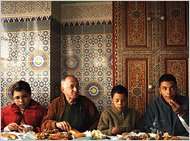
Considered by many to be Spain's greatest living writer, Goytisolo is in some ways an anachronistic figure in today's cultural landscape. His ideas can seem deeply unfashionable. For him, writing is a political act, and it is the West, not the Islamic world, that is waging a crusade. He is a homosexual who finds gay identity politics unappealing and who lived for 40 years with a French woman he considers his only love. "I don't like ghettos," he informed me. "For me, sexuality is something fluid. I am against all we's." The words most commonly used to describe his writing are "transgressive," "subversive," "iconoclastic."
For much of the last 25 years, Goytisolo has lived in a kind of Paul Bowlesian exile in an old house in Marrakesh's medina. In Morocco, he has been able to indulge his passion for Muslim culture — a passion that includes a scholarly interest in Sufi theology, the finer points of Arabic and Turkish grammar and a self-confessed predilection for working-class Arab men.
Read more here...
Don’t Punish Youth for Speaking Out
My friend Nancy Ambriz and I wrote this Op-Ed for the Houston Chronicle on Wednesday, March 29 after the student walkouts in Houston and across the country. They didn't publish it, so it might as well be here for all to read... JP
Miriam is a 17 year old student at North Shore Senior High School in East Houston. Her mother carried her across the Rio Grande when she was four years old. She has been active for several years in different community groups, fighting so that when she finishes her studies she will be able to work even though she has no Social Security number. Miriam walked out of school on Tuesday in protest of HR 4437, James Sensenbrenner’s bill, which would make her and her family into instant felons.
For years, students in Houston have been too scared to take actions like this, fearful for themselves and for their families and friends. But now, after last Saturday’s march of half a million people in Los Angeles and others across the country calling for earned legalization, students see that they can speak out too. In Houston last Saturday, there was a march sponsored by a group of young immigrant rights activists, in support of the DREAM Act which would provide a path to citizenship for successful high school and college students. The thousands of youth that turned out for this march are the informed leaders in their schools and communities. This week many of their classmates walked out with them.
The walkouts around the country, while often unorganized and impulsive, are the understandable product of a country that has left young people, especially young Latinos, out of the debate.
For years, many students in Houston and across the country have been working on the frontlines on immigration issues, because they affect them on such a personal level. Undocumented students like Miriam can study, work hard in school, strive to succeed and in the end, they will not be able to get a job because they do not have papers. Immigrant families are split on different sides of the border. Many have seen their own relatives deported or living in fear.
Surely all the young people that walked out of their schools cannot articulate perfectly the goals of their actions. But each and every one is drawing from their own personal experience. In the heat of the moment, it’s difficult for anyone to express all the reasons and the historical context for their actions. The walkouts are a visceral, emotional response to years of suffering and bottled up frustration. They carry the flags of their (or their parents’) countries of origin as a reaction to a society that tells them they do not exist. They carry American flags with hope for the future.
Their opinions might not be perfectly expressed or developed, but their frustration is clear.
In Washington and in most of the country, laws (like Sensenbrenner’s HR 4437) are made as if these young people did not even exist.
Despite their good intentions, a backlash is already building against the students. Naysayers on local television stations and in the blogosphere have labeled the students ignorant and uninformed. The response from area police departments and school districts has been arrests in the streets and citations for curfew violations. As was shown on all the local Houston television stations, students have been handcuffed, chased, and harassed. In their schools, they have been threatened with punishment and often put on lock-down.
Just last week, Houston City Council Members debated expanding the curfew on young people. One Council Member wisely asked for students to be involved and consulted before a decision was made. When those young people speak, surely they will ask for the curfew law to be changed to allow for peaceful protest. The schools have to deal with students leaving class on a case by case basis, but, under no conditions, should it be illegal for students to protest. They should not be arrested for expressing themselves, reacting to a society that would criminalize them or their families and friends for their very existence in this country.
Some commentators, including right-wing local politicians, have said that the kids just wanted to leave school. All across the metropolitan area, students left school on a rainy, cold day in order to make their voices heard. They took to the streets with bravado and with little pre-organization.
We would be wise to remember that young people have been at the forefront of all the historical movements for social change in our country, from the African American civil rights movement to the Chicano movement. Often, the opening stages are messy, emotional and loud. This one is no different. While, at this time, there is not a high degree of organization, the energy and the spirit for change are obvious.
We should recognize this week’s walkouts as reactions to a society that excludes young people, especially Latinos and the undocumented, and support them in their actions, not criminalize them in the very moment when they are finding their voices. The conventional wisdom is that since young people and the undocumented do not vote, therefore they are not important. Hopefully, these walkouts and marches will change that perception; these are voices our nation must hear.
Miriam will graduate from high school this year. She has not been to Mexico since she was four years old. She is home already. And, right now, we would do well to listen to her, instead of punishing her.
Miriam is a 17 year old student at North Shore Senior High School in East Houston. Her mother carried her across the Rio Grande when she was four years old. She has been active for several years in different community groups, fighting so that when she finishes her studies she will be able to work even though she has no Social Security number. Miriam walked out of school on Tuesday in protest of HR 4437, James Sensenbrenner’s bill, which would make her and her family into instant felons.
For years, students in Houston have been too scared to take actions like this, fearful for themselves and for their families and friends. But now, after last Saturday’s march of half a million people in Los Angeles and others across the country calling for earned legalization, students see that they can speak out too. In Houston last Saturday, there was a march sponsored by a group of young immigrant rights activists, in support of the DREAM Act which would provide a path to citizenship for successful high school and college students. The thousands of youth that turned out for this march are the informed leaders in their schools and communities. This week many of their classmates walked out with them.
The walkouts around the country, while often unorganized and impulsive, are the understandable product of a country that has left young people, especially young Latinos, out of the debate.
For years, many students in Houston and across the country have been working on the frontlines on immigration issues, because they affect them on such a personal level. Undocumented students like Miriam can study, work hard in school, strive to succeed and in the end, they will not be able to get a job because they do not have papers. Immigrant families are split on different sides of the border. Many have seen their own relatives deported or living in fear.
Surely all the young people that walked out of their schools cannot articulate perfectly the goals of their actions. But each and every one is drawing from their own personal experience. In the heat of the moment, it’s difficult for anyone to express all the reasons and the historical context for their actions. The walkouts are a visceral, emotional response to years of suffering and bottled up frustration. They carry the flags of their (or their parents’) countries of origin as a reaction to a society that tells them they do not exist. They carry American flags with hope for the future.
Their opinions might not be perfectly expressed or developed, but their frustration is clear.
In Washington and in most of the country, laws (like Sensenbrenner’s HR 4437) are made as if these young people did not even exist.
Despite their good intentions, a backlash is already building against the students. Naysayers on local television stations and in the blogosphere have labeled the students ignorant and uninformed. The response from area police departments and school districts has been arrests in the streets and citations for curfew violations. As was shown on all the local Houston television stations, students have been handcuffed, chased, and harassed. In their schools, they have been threatened with punishment and often put on lock-down.
Just last week, Houston City Council Members debated expanding the curfew on young people. One Council Member wisely asked for students to be involved and consulted before a decision was made. When those young people speak, surely they will ask for the curfew law to be changed to allow for peaceful protest. The schools have to deal with students leaving class on a case by case basis, but, under no conditions, should it be illegal for students to protest. They should not be arrested for expressing themselves, reacting to a society that would criminalize them or their families and friends for their very existence in this country.
Some commentators, including right-wing local politicians, have said that the kids just wanted to leave school. All across the metropolitan area, students left school on a rainy, cold day in order to make their voices heard. They took to the streets with bravado and with little pre-organization.
We would be wise to remember that young people have been at the forefront of all the historical movements for social change in our country, from the African American civil rights movement to the Chicano movement. Often, the opening stages are messy, emotional and loud. This one is no different. While, at this time, there is not a high degree of organization, the energy and the spirit for change are obvious.
We should recognize this week’s walkouts as reactions to a society that excludes young people, especially Latinos and the undocumented, and support them in their actions, not criminalize them in the very moment when they are finding their voices. The conventional wisdom is that since young people and the undocumented do not vote, therefore they are not important. Hopefully, these walkouts and marches will change that perception; these are voices our nation must hear.
Miriam will graduate from high school this year. She has not been to Mexico since she was four years old. She is home already. And, right now, we would do well to listen to her, instead of punishing her.
Gulf Coast (Dis)Placed
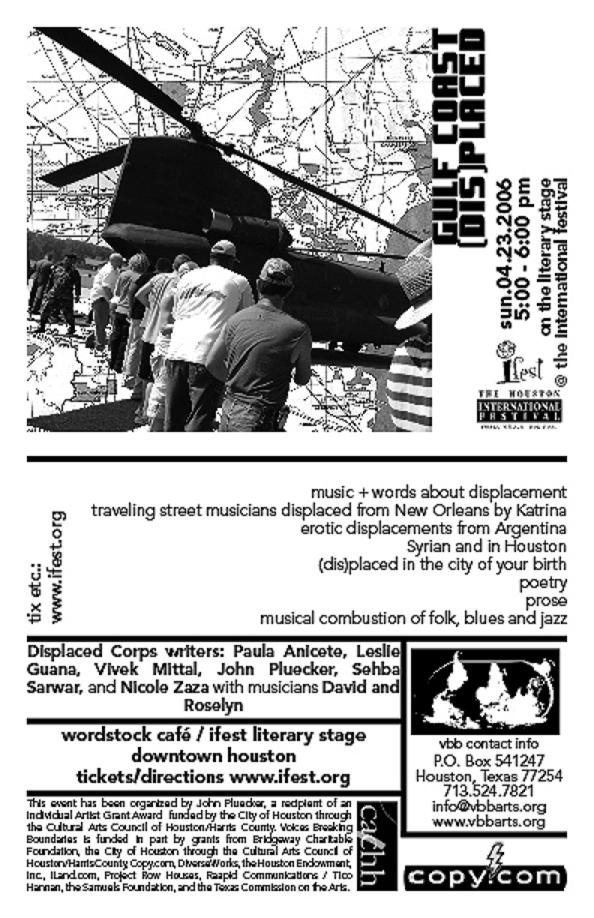
Come out this sunday to I-Fest (the Houston International Festival) downtown Houston at 5pm! There will be an hourlong show with music and six readers (including me), called Gulf Coast: (Dis)Placed.
Suscribirse a:
Entradas (Atom)