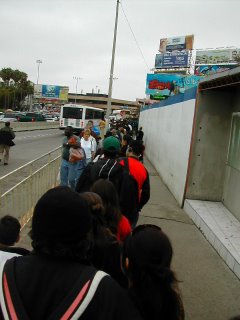
 Since arriving to San Diego on Sunday morning, I have crossed the border six times. Crossed the San Ysidro/Tijuana garita four times by car and twice on foot. By foot, its two hours to cross most days from the place I’m staying in Colonia Chapu, first by car, then walking to cross the border, then trolley, then bus, then walking to the Lab Fronterizo. The organizers, especially Cristina Rivera Garza, want us to experience the daily crossing of the border. I see why.
La frontera - long lines of people, thousands of people, thousands of cars and trucks in line. Two systems of transportation, two languages, a crush of humanity. Mexico, Mexico world cup shirts for sale on every corner. My stomach tight with god-knows-what emotion. The crossing, the millions who cross this border every day to go to work on the other side.
The stories. The immigrant trafficker killed right there, right there where they closed down the entrance to Mexico when the guy tried to escape from Otay, escape back into Mexico. The cameras on each side of each lane mark that place where they Migra shut the border down. We drive by, the place we drive through, the place we walk by, where they shot him down as he tried to get back to his country. On that hill, that hill right there where the Border Patrol shot down a man as he tried to escape from them. He, steps away from la Patria, shot down before he could cross back over. A new Tijuanense friend tells me what he heard from the Border Patrol-employed husband of a mexicana friend of his...that in training the Border Patrol agents are taught to shoot to kill, because a maimed person, an injured person, una persona balaceada, will cost more to the US government than a dead person. Dead not alive, entonces.
I don’t know where to start with this border, I don’t know how to get my head around it. It is at the limits of what is understandable.
A small detail: in Houston, when we listen to the radio, we switch between Spanish stations, English stations, Vietnamese stations, Chinese, more and more. Here, when someone speaks English on the radio, the signal is literally coming from another country, from across the line, al otro lado de la frontera. Borders are physical here, national, backed by a whole state system and it makes the borders we cross every day more visible.
The rush of people, the rush of commerce, the stench of car exhaust, the mountain in the distance, one side covered with homes, with concrete block walls, and visible traffic, glistening cars and up and down the hill and across on roads that network all across the mountain through dense neighborhoods. This Tijuana pushed up against the border fence. And across it, on the other side, the same mountain, the exact same one with nothing but shrubs and Border Patrol dirt roads and tracks that make a spiders web of beige lines on the desolate, empty hill. One hundred years ago, there were a few hundred people living in Tijuana, now more than two million. A hazy, green-tinted sky that unites us.
En la fila peatonal, the pedestrian line, the people cram up on you, from behind and in front, everyone sweating, some talking and happy, some bored, some clearly angry and frustrated. A line of fifteen people with their hands behind their backs files down the other side of the long hallway, filing back to Mexico carrying zip lock baggies with their possessions. Los deportados. And you walk forward to cross.
Some people, los que abusan del sistema, cut corners and walk ahead of you in the line. The people that walk ahead are of no particular type. They are from every background: a young black boy, alone, sipping his McDonalds orange drink in a baggy white sweatshirt, a family of white tourists the blonde haired, overweight mom talking loudly about how expensive houses are in San Diego now, how they can’t afford $240K for 900 square feet, the old mexicano man, with his baseball cap, hunched over with his cane, the military guys visiting Tijuana for a blast, the daily Tijuanense commuter the one who is probably late for work and doesn’t wait in line today...all these people cutting to the front past you, rushing past you.
And what do you do? What do you do in any situation like this, where you are doing what the system says, you are in the right, you think, following orders, though mind numbing and horrible and boring, there is something that says, yes, you do this, you do what you should do, you get the reward in heaven, or if you don’t believe in heaven, you get no reward but you still wait. See, it’s not just the people passing you in line, it’s humanity, it’s humanity rushing forward and unless you scream, unless you yell at them to get back, to wait in line like the rest of us, unless you protest, well, maybe even if you do, they rush ahead to the front. Get back here with the rest of us. Do you skip the line too? Or do you stay in it? Save some time, cut some corners. I stayed in my place, the guy behind me said, “Es una falta de educación, de ética, pues”.
It’s a metaphor, see, or maybe a synecdoche. Just a small piece of the puzzle, how we are as humans. Rushing ahead, putting up borders, trained to want to be a winner no matter whose toes you have to step on, no matter the people waiting in line, patiently 24 hours a day, seven days a week, 365 days a year. It’s not just in the line, but at work, at school, en cualquier lugar pues.
We wait in line, careful, weary, cautious, watchful, we wait in line.
 Estaba googleando "buga" para ver que había en el internet y encontré este blog hoy de un chavo en Quintana Roo. Me dió mucha risa su "About Me" en su blog. Dice:
Freak, Geek y Queer. Diferente entre los diferentes, único, lleno de imaginación, estilo, y con la sexualidad a más no poder. Adicto a conducir, adicto al sexo, adicto a la compañía humana. Incoherente, desvariante, incomprendido, convincente, entregado, y aunque usted no lo crea fiel. Siempre en la búsqueda de lo que no puede tener. Soy un buen amante, pero nunca podrá comprobarlo, eso es solo para él. Mi poder mutante: Saber los malos pensamientos, sentir las malas intenciones, conocer la verdad detras de las palabras. Mi debilidad: Ser pendejo para estacionarme.
It's so cute and sweet and tender and arrogant and cocky. Perfect. También la foto. The blogosphere is full of crazy people, full of hibiscus and rooster headdresses.
Parece que el New York Times llegó antes de mí a Tijuana. Whatever. They jus wanna be kool.
And, um, could they even mention literature? Damn, what's a brotha gotta do?
 If you haven't read the blog Baghdad Burning yet, you really should. It is written by an Iraqi woman in Baghdad. I don't know much else about her besides that fact and that her writing consistently cuts through the media fog and speaks from the streets and the homes of occupation Iraq. She wrote this on Saturday about Zarkawi...How do I feel? To hell with Zarqawi (or Zayrkawi as Bush calls him). He was an American creation- he came along with them- they don't need him anymore, apparently. His influence was greatly exaggerated but he was the justification for every single family they killed through military strikes and troops. It was WMD at first, then it was Saddam, then it was Zarqawi. Who will it be now? Who will be the new excuse for killing and detaining Iraqis? Or is it that an excuse is no longer needed- they have freedom to do what they want. The slaughter in Haditha months ago proved that. "They don't need him anymore," our elderly neighbor waved the news away like he was shooing flies, "They have fifty Zarqawis in government."Read more here. If you have some disposable income and you like to buy books, you should also buy hers.
 There is an interesting movie here on the PBS-Frontline site about Karina Parra, a transgender woman in Santiago, Chile and her struggles to live and grow. It also talks about the transgender rights group, TravesChile, which now has 13 branches across the country! I recommend checking it out. Here.I have some issues with the filmmaker. I wonder why she did not go a little deeper into the subject. The woman in the film, injects silicone into her hips to try to feminize her body. This is something working class transgender women do around the world. I would like to have seen a little context in the film. I understand why people inject silicone, but it is a huge risk, a life or death kind of risk. The treatment seemed a little sensational and not educational. In any case, I posted a comment on the site to try to help Karina out, donate some money or raise some funds to help her get the sex change surgery she wants and needs. We'll see if they respond and maybe we can try to help in some way. Start by watching the movie.
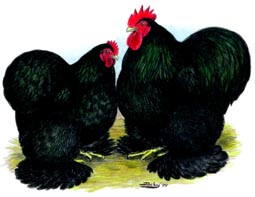
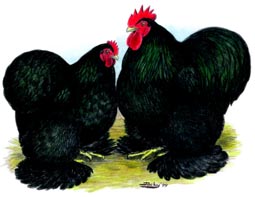 A chicken (una gallina) arrived about a month ago and took up residence in the neighbor’s yard. The neighbors are two people, an elderly Italian lady and her twenty-something son. Their family has been in the neighborhood more than sixty years, much like mine, and they have stayed in the neighborhood all this time (much unlike mine). The chicken has lived in their yard, pecking around in the grass eating god-knows-what, slogging through five-inch deep May downpour puddles, sleeping in the hibiscus trees in the front of the one-story 1920’s brick bungalow.
Yesterday we awoke to sounds of thrashing, the neighbor boy was running around the yard chasing the chicken with the help of his little terrier, chasing the chicken with a stick. When asked what he was doing, he said: I’m at my wits end, that chicken is terrorizing my cats, the chicken eats all the cat food, it doesn’t let the cats eat the food, it is out of control —¡that wily chicken!— and I’ve had enough.
A step back: we had tried about a month ago when the chicken first arrived to take the it before and move it to our yard, but he flew over the fence and went back to the neighbor’s yard. Now we knew why: the cat food.
But now watching the neighbor boy chase the chicken, we decided that the chicken had to have a better home. We told the neighbor boy to stop chasing the chicken, that it was much easier to catch a chicken at night as they slept.
So last night we climbed up on a small ladder, step stool type thing and took that chicken. Pero, y aquí el gran pero, nuestro amigo tamaulipeco que vive en la casa con nosotros nos aconsejo que el mejor idea sería de atar un hilito a la patita de la gallina para que no se escapara en la noche. También otros dijeron que así se hacía en el rancho. Que se tenía que atar la gallina a un árbol o ligar sus dos patitas para que no caminara tanto. So on the advice of this friend we tied a string to the gallina’s patita and tied it to a tree.
In the morning, we found the chicken hanging from the tree. Se había enrededado por completo en el árbol. We got him loose. The chicken, we thought, must have a broken leg or a broken wing. It sat still in the dirt, didn’t move, didn’t try to escape, looked traumatized. We learned from our mistake. We wouldn’t tie any chicken, ever again, so we put it in a box with chickenwire across the top to keep the gallina inside. Later, today, the chicken seemed to be fine, it even escaped from the box and tried to get away. But I caught it, put it back in the box and secured the chickenwire top.
During my lunchbreak, I went to Hendrick’s Feed Supply, Founded 1923, an oldtime feedstore on Harrisburg in the middle of Magnolia. Who knows how this feedstore survives almost a century later despite all the changes? I bought the hen a mixture of normal feed (4lbs) and special pellets that help with egg laying (3lbs). Total $2.74.
We named the gallina-hen, Clementina, on the suggestion of a friend who always wanted to name a gallina, Clemenina. Y además, Clementina es naranja y así que tiene sentido llamarle Clementina.
Clementina is like Hendrick’s is like me. Reaching for the past. A legacy of rural life, a living breathing connection to the past. To the grandmother whether here in el East End or allá en el rancho norteño que siempre cuidaba sus gallinas. For the store that refuses to die despite it all, the Wal-Marts, the agrodecline, who finds a place for feedstore on a street now full of thrift stores, Las Palmas strip mall, El Charro taquería, La Marbella banquet hall, Fallas Paredes, Firestone, murals of Lidia Mendoza playing the accordeon, cholos and agringados, old Italian ladies, and who keeps chickens anymore? A lot of people, a lot of people, in the belly of the beast, in the glossy, flossy postmodern city, in this place where there is supposedly nothing natural, where the rain is chemicals and scorched hot by the firey burn-off from the smokestacks of the refinery.
Chickens escape. Las gallinas vagan por las calles, se asentan en los patios de los viejos residentes, se enredan en los arboles y cuelgan esperando hasta que alguien las salve. And somehow Clementina found her way to our backyard. Now we just have to learn how to take care of her, how to take care of our roots, what we’ve lost, how to recover it, how not to get broken and lost, killed by the neighbor in a fit of anxiety or rage, how not to get lost in the cracks.
Bueno pues, I came across a text today that purported to provide the rules for using a “foreign tongue” when writing in English. One can only use “foreign” language as one would use a dialect, to emphasize the foreignness, to make the foreignness more present for the reader as in: I want to eat chilaquiles or That boy loves these tacos or My mom makes great pasteles. Pero cuando se explora un concepto más grande o se utiliza una frase más larga (but when a larger concept is being explored or a longer phrase utilized) one must repeat the meaning of the phrase in English in order to never ever lose the monolingual reader. Me cae super-gordo todo esto. I don’t want to always think about the monolingual reader. My favorite writers don’t always worry about the monolingual reader. I remember about six years ago at a Queer Aztlán conference in Austin, I heard Cherríe Moraga say, I want to read writers who write for me. I’m sick of reading writers who aim for el lector promedio. I’m ready for writers who push the boundaries, who aren’t afraid to lose el lector promedio, monolingüe, who write for bilingual Chicana lesbian feminists and caring tampiqueña Move-On members who studied in Iowa and over-educated red diaper Jews who study Zion and tijuanenses bilingües que leen este bloguito. Como dicen en la radio aquí en Houston: ¡And Proud! Y que vayan a la chingada todos los demás (and fuck all the rest).
I've been thinking for a while about this blog, about how to write about "personal" topics. I mean, I know I want to write about political things, literary things, but the personal piece seems a whole lot harder...like who checks this thing? What do I want whom to know? And it all becomes complicated. After all, do I (or we) really control what other people know anymore? Have we ever?
Rumors have always taken the secrets of people and transmitted them. People have always had images of other people, ideas about how they are that get transmitted from one person to another. But now, Google has worked wonders to tear down any shred of personal or private life left. A quick search of anyone's name gives a whole panorama of who that person is, a window on what they have done and how they have registered him or herself in the world. Especially if you have a particularly unique first or last name.
Intellectually, I can take apart the entire concept of something personal and private, removed from the communal. I also reject privacy as an end. As a means it might be productive, but as an end, it seems to only lead to bourgeois comfort and seclusion from the rowdy, unwashing masses. But emotionally, it is a lot more difficult. What does privacy protect? What can we keep private? What is it worth keeping private?
Maybe it's like the kid who comes out of the closet to his friends and family and everyone says, "Yeah, we knew the whole time, we were just waiting for you. Wondering why you hadn't talked about it yet." Everyone probably already knows or can find out just about everything about you anyway. No use hiding then.
I have been looking at some other blogs too, to see how other people are negotiating these questions. See Gwendolyn Zepeda's blog. Or Liliana Blum's blog. Or Heriberto Yépez' blog. Or Moorishgirl. There are a lot of ways to talk about yourself or not talk about yourself.
Clearly, I won't resolve this in this post, but anyhow, just putting it out there as a question seems important. How do you, if you blog, deal with this?
There is a great article by Heriberto Yépez here. In it, he (a prolific writer in Tijuana) writes about the relationship between the US and Mexico on the eve of May 1. It seems like he wrote it just before the "Day without an Inmigrant" reflecting on what the boycott means and what our national relationship means. Más allá del sicoanálisis que varios intelectuales han aplicado, sin éxito por cierto, a México, lo que debe hacerse este 1 de mayo es un terapia de pareja México-Estados Unidos, porque ambos países son un mismo cuerpo, son dos aspectos de una misma co-dependencia. Hay entre ellos una esquizofrénica relación: la del amo frustrado y el esclavo saboteador. Un danzón donde se cuela una terrible realidad: Estados Unidos somos nosotros. Y ellos son México.His conclusion is "We are the United States. And they are Mexico." My conclusion is "We are Mexico. They are the United States." It's a great article. Maybe I should translate it? If you want me to translate part of it, say aye!